The most cost-effective 8x L40S rental in North America.
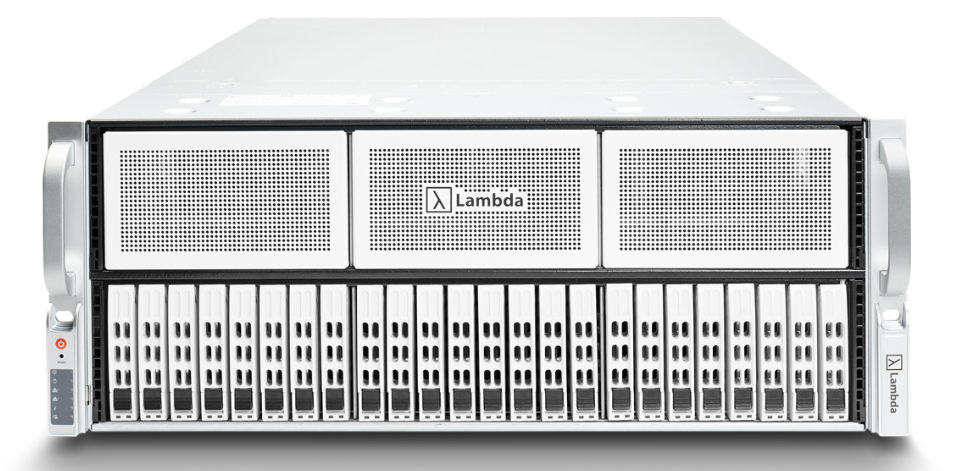
Rent a Scalar 4U with eight NVIDIA L40S GPUs by the month. 384GB GDDR6, FP8 Transformer Engine, dual Intel Xeon Gold, 1TB DDR5 — purpose-built for fine-tuning, batch inference, and rendering.
Aggregate FP16 tensor throughput across all 8 GPUs, with FP8 support via 4th-gen Transformer Engine.
48GB per GPU — large enough for 70B-class models in 4-bit quantized inference on a single card.
Tier III+ colocation with redundant power, cooling, and 24/7 NOC available out of the gate.
Specifications
L40S excels at LoRA/QLoRA fine-tuning of 7B–70B models, vLLM/TGI batch inference, Stable Diffusion XL, and Omniverse rendering pipelines.
4th-gen Tensor Cores deliver up to 1466 TFLOPS FP8 per GPU — roughly 2x the FP16 throughput for transformer workloads.
Bare-metal dedicated hardware — not a slice of someone else's H100. Full root, full bandwidth, full TDP.
Start bare-metal at $10K/mo, add colocation, on-site delivery, or our managed engineering team at any contract boundary.
What teams actually run on 8× L40S
The L40S sits in the sweet spot for production AI: enough memory and compute for serious models, without the H100 price tag or supply constraints. Here are the workloads we see customers deploy most often.
Serve Llama 3.1 70B, Mistral Large, Qwen 2.5, or DeepSeek-V3 to your users with vLLM, TensorRT-LLM, or SGLang. FP8 quantization gives ~2× the throughput of FP16, and 384 GB of GDDR6 across the node means you can pin a full 70B model and still have headroom for KV cache on long contexts.
LoRA and QLoRA fine-tuning of 7B–70B models fits comfortably on the L40S. Teams use it for domain-adapted medical, legal, and finance models — full-parameter fine-tunes of 7B–13B models, or parameter-efficient tuning of 70B.
Stable Diffusion XL, FLUX.1, SDXL Turbo, and ControlNet pipelines run multiple concurrent generation streams per GPU. Great for image-gen SaaS backends, batch creative asset generation, and synthetic data pipelines.
Three NVENC and three NVDEC engines per GPU (including AV1 encode) make the L40S unmatched for video AI: real-time transcoding farms, VOD pipelines, video upscaling (Topaz, Real-ESRGAN), and AI video models like Stable Video Diffusion or Mochi-1.
Object detection, segmentation, OCR, medical imaging (MONAI), genomics inference, and protein structure prediction (AlphaFold, ESM) all run well within a single L40S's 48 GB. The 8-GPU node lets you parallelize hyperparameter sweeps and ensemble inference cleanly.
142 third-gen RT Cores and NVIDIA Omniverse certification mean the same hardware that serves your LLMs can also drive real-time ray-traced simulation, USD-based digital twin pipelines, and Unreal Engine rendering for industrial and architectural visualization.
Inference, fine-tuning, or training — which is the L40S for?
Modern ML workloads sit on a spectrum. At one end, frontier-model pretraining (multi-trillion-token runs on 405B-parameter models) needs the NVLink fabric, HBM3 bandwidth, and SXM form factor of H100 or H200 — that's a different tool. At the other end, low-volume batch inference can run on consumer cards.
The L40S is built for the wide middle: production inference at real traffic, continuous fine-tuning on proprietary data, RAG pipelines with embeddings + reranking + generation on the same node, and the smaller-scale pretraining runs (1B–13B models) that dominate vertical AI work. With 91.6 TFLOPS of FP32, 366 TFLOPS of TF32 with sparsity, 733 TFLOPS of FP16, and 1,466 TFLOPS of FP8 — per GPU — an 8-card node gives you roughly 11.7 PFLOPS of FP8 transformer compute.
Practically: if you're shipping AI features in production rather than chasing GPT-5-scale pretraining, the L40S is almost always the right cost-per-token answer, and the 48 GB per card removes the memory cliffs that A100 40 GB and L4 24 GB hit on modern long-context workloads.
Privacy and security: your data, your hardware, your keys
If your training data is regulated, your model weights are proprietary, or your inference traffic carries customer PII, public cloud GPU instances are the wrong shape. Bare-metal L40S rentals are designed for teams that need to prove who touched what.
You get the entire physical server. No hypervisor, no neighboring VMs, no shared memory bus, no side-channel exposure to other customers. Side-channel attacks (Spectre/Meltdown class, GPU memory bleed) only matter when someone else is on the silicon — here, nobody else is.
Bring your own LUKS / dm-crypt keys at provisioning, integrate with your KMS or HSM, and we never escrow them. Model weights, training data, and inference logs stay encrypted at rest under keys we can't read.
For HIPAA, ITAR, CJIS, and classified workloads, we can deliver and install the Scalar L40S server inside your own facility — behind your firewall, on your network, under your physical access controls. The data never crosses our perimeter.
At end-of-term we cryptographically erase or physically destroy all NVMe drives per NIST SP 800-88 Rev. 1, with signed certificates of destruction. Default for every contract — not an upsell.
Deploy with private VLAN to your colocation cage, IPsec or WireGuard tunnels to your VPC, or 100G direct-connect uplinks. The server doesn't need a public IP if your workload doesn't want one.
Our Tier III+ colocation partners run SOC 2 Type II, HIPAA-aligned, and ISO 27001 certified facilities with 24/7 staffed security, biometric access, and full camera coverage. We can sign BAAs and DPAs for regulated workloads.
Why private GPU infrastructure matters for regulated AI
Healthcare, financial services, defense, and legal customers increasingly can't ship workloads to multi-tenant cloud GPU providers — not because the providers are untrustworthy, but because the compliance evidence chain is thinner when a hyperscaler's hypervisor sits between your model and your data. HIPAA, GLBA, ITAR, EU AI Act, and emerging state-level AI laws (Colorado AI Act, California SB-1047 follow-ons) all push toward demonstrable control over where models train, where weights live, and who can subpoena them.
Dedicated L40S hardware gives you a clean answer to every auditor question: this server, this serial number, this rack, these keys, this datacenter, these access logs. Pair it with on-site deployment and the answer gets even simpler — the data never leaves your building.
Frequently asked
How does the L40S compare to the A100 for LLM inference?+
For FP16/BF16 inference on models up to 70B params, an 8x L40S node delivers comparable tokens/sec to an 8x A100 80GB node at roughly 40–60% of the rental cost, because the L40S also supports FP8 via the 4th-gen Transformer Engine. Training throughput on very large models favors A100/H100 due to NVLink, so L40S shines for fine-tuning, batch inference, and rendering.
Is NVLink available on the L40S?+
No. The L40S uses PCIe Gen4 x16 only (no NVLink bridge). For tensor-parallel training across 8 GPUs you'll rely on PCIe + NCCL — which is fine for fine-tuning and inference, but pure training of frontier-scale models benefits from H100 SXM with NVLink.
Can I rent a single L40S instead of the full 8-GPU node?+
Our rentals are full-server (8x L40S in a Scalar 4U chassis). You can run multiple isolated workloads with MIG-style partitioning at the orchestration layer, but the hardware is allocated whole.
How fast can you ship?+
We hold Scalar L40S systems in stock at our Carlsbad, CA facility. Bare-metal and colocation deployments typically go live in 7 business days; on-site installs depend on your facility readiness.
Is the L40S good for video and rendering workloads?+
Yes — the L40S has 142 third-generation RT Cores and dedicated NVENC/NVDEC media engines (3x NVENC, 3x NVDEC per GPU including AV1 encode). An 8-GPU node can encode dozens of concurrent 4K streams, render Omniverse / Unreal scenes, or batch-transcode video libraries far faster than CPU-only pipelines.
Can I keep my data and model weights private?+
Yes. Dedicated bare-metal rentals mean no hypervisor, no shared tenants, and no cloud-provider key custody. You hold the encryption keys, choose the OS image, and can require us to wipe drives at end-of-term per NIST SP 800-88. On-site deployments at your facility keep data behind your own firewall end-to-end.
Lock in your L40S allocation.
In-stock units ship in 7 days. Configure your deployment in under 2 minutes.